
Restaurant Popelier, Gooik — Silver Star, Best Long List, Star Wine List of the Year Belgium 2026
On 21 September 2026, at Marcel in Antwerp, Star Wine List announced the winners of its fourth Belgian competition. Restaurant Popelier, in Gooik, took a Silver Star in Best Long List.
It is worth pausing on which award that is. Not best restaurant. Not best sommelier. Not best cellar. The award is for the wine list itself — the document, the selection, the thinking behind it. Popelier has been a COENA customer since March 2023, so we have a partial view of what sits behind that list. We want to be precise about which part is theirs, because almost all of it is.
What “Best Long List” actually means
Star Wine List splits its categories by size, and Best Long List is the deep end: wine lists carrying more than 600 references. That is the entry threshold, not the achievement. The achievement is being judged, at that size, to have curation worth recognising.
Six hundred references is not a marketing number. It is an operational commitment renewed every service. Every one of those wines has to be in stock when it is offered, priced correctly, findable in the cellar by whoever is on the floor tonight, and off the list the moment the last bottle goes. At 200 references that is demanding. At 600 it is a different category of problem, and it is the reason most restaurants never go there.
Belgium first
The structure of Popelier’s list tells you something before you read a single producer. Open the white wines and the first country is not France. It is Belgium — Flanders and Wallonie — sitting above Italy, and above a France section that holds Burgundy, Champagne, Alsace and Jura.
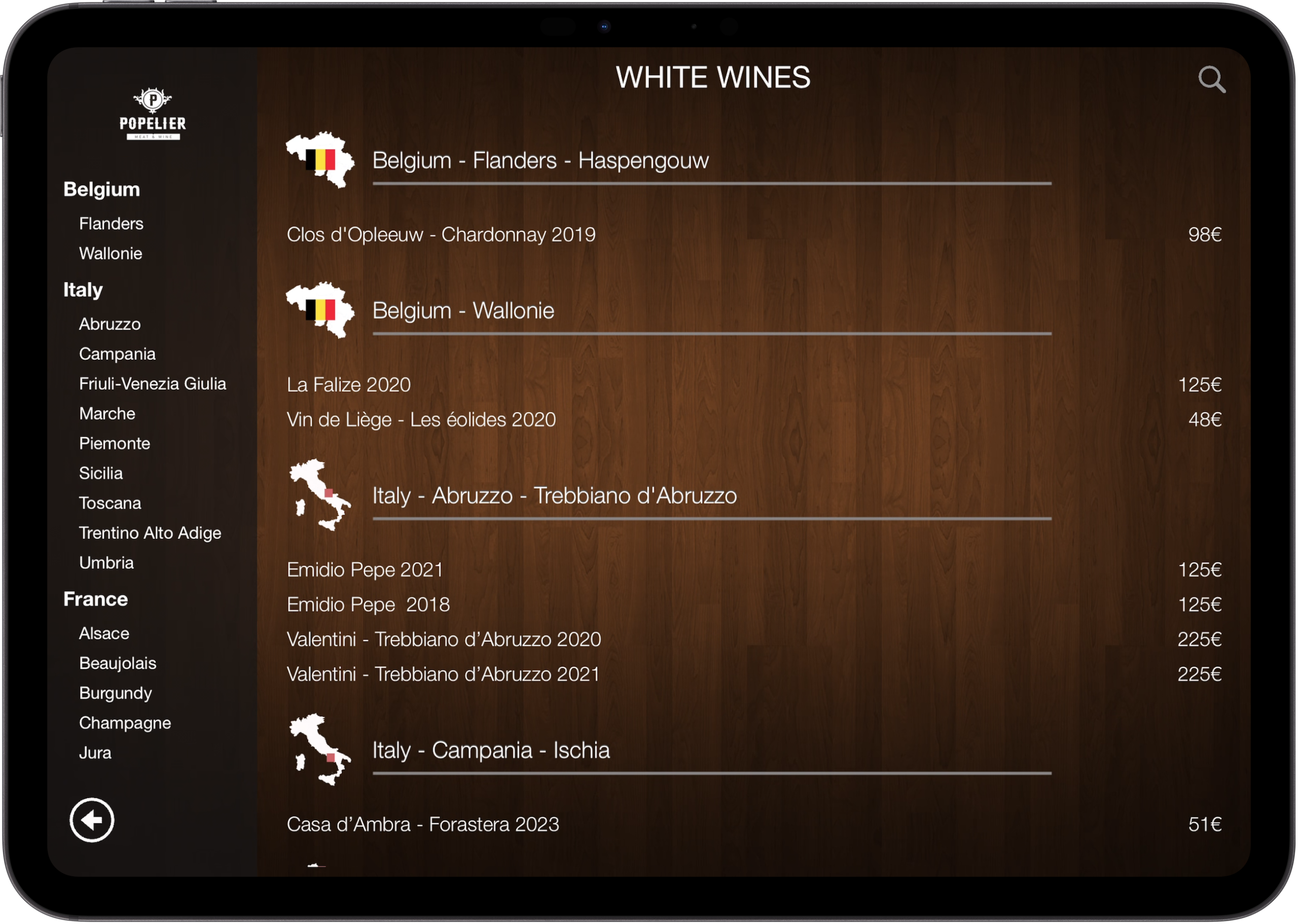
That is not the software’s default. In COENA, the sommelier or F&B manager chooses which countries are showcased at the top of the filters, so that local growers lead rather than waiting their turn. Everything after the showcased countries falls into alphabetical order — which is why France, alphabetically ahead of Italy, sits third here rather than second.
Popelier has used that setting to put Belgian wine in front of the guest first: Clos d’Opleeuw’s Chardonnay from Haspengouw, La Falize and Vin de Liège from Wallonia.
It is worth noticing what sits immediately below them. Emidio Pepe and Valentini — two of the most collected names in Italian white wine. Choosing to lead with Belgian bottles above that, on your own list, in your own country, is a position rather than a filing convention.
Open the reds and Belgium is not there at all. Not because the ordering changes, but because Popelier does not list Belgian reds. Italy takes the front instead — thirteen regions, Abruzzo through Veneto, before the first French one, with Chiara Condello in Romagna and a full run of Ar.Pe.Pe from Valtellina.
That is what a jury recognises when it gives a Silver Star for a long list. Depth is easy to fake by counting bottles. Depth that carries a point of view across six hundred references is not.
The part nobody sees
Here is the unglamorous half of a list like this, and it is the half that decides whether the guest experience matches the ambition.
A vintage changes. A grower’s allocation runs out. A price moves. A bottle is sold at table eleven and is now gone. On paper, each of those events sets off a small administrative chain: find the line, change it, reprint the page, and — because a wine list is usually a folded sheet — effectively reprint the list. Restaurants that try to run 600 references on paper end up choosing between a list that is current and a list that is affordable to maintain.
The failure that matters is not administrative, though. It is a sommelier recommending a wine that sold out during the first service, in front of a guest who has just been persuaded to want it. At 600 references, without a system, that is not a risk. It is a certainty.
Joachim Pletinckx, who manages Popelier, describes what it actually takes:
“With a wine list of more than 600 references, the key is having a system that keeps the stock continuously up to date, connects directly with the POS and instantly shows where every bottle is located in the cellar — making it easy not only for the sommelier, but for everyone working on the floor. Being able to export a complete stock list every quarter, including purchase and selling prices, is another huge advantage — a dream compared to the manual Excel sheets we used to work with.”
— Joachim Pletinckx, Manager, Restaurant Popelier
Where COENA fits
Narrowly, and we would rather say so plainly than take credit for someone else’s award.
The selection is Popelier’s. The depth is Popelier’s. The decision to open on Abruzzo rather than Bordeaux is Popelier’s, and it is the part being recognised here — the part no software can do. What COENA handles is the maintenance: stock, vintages, availability and pricing kept current, so that the list a guest reads still matches the cellar behind it, and a change made once lands everywhere it needs to.
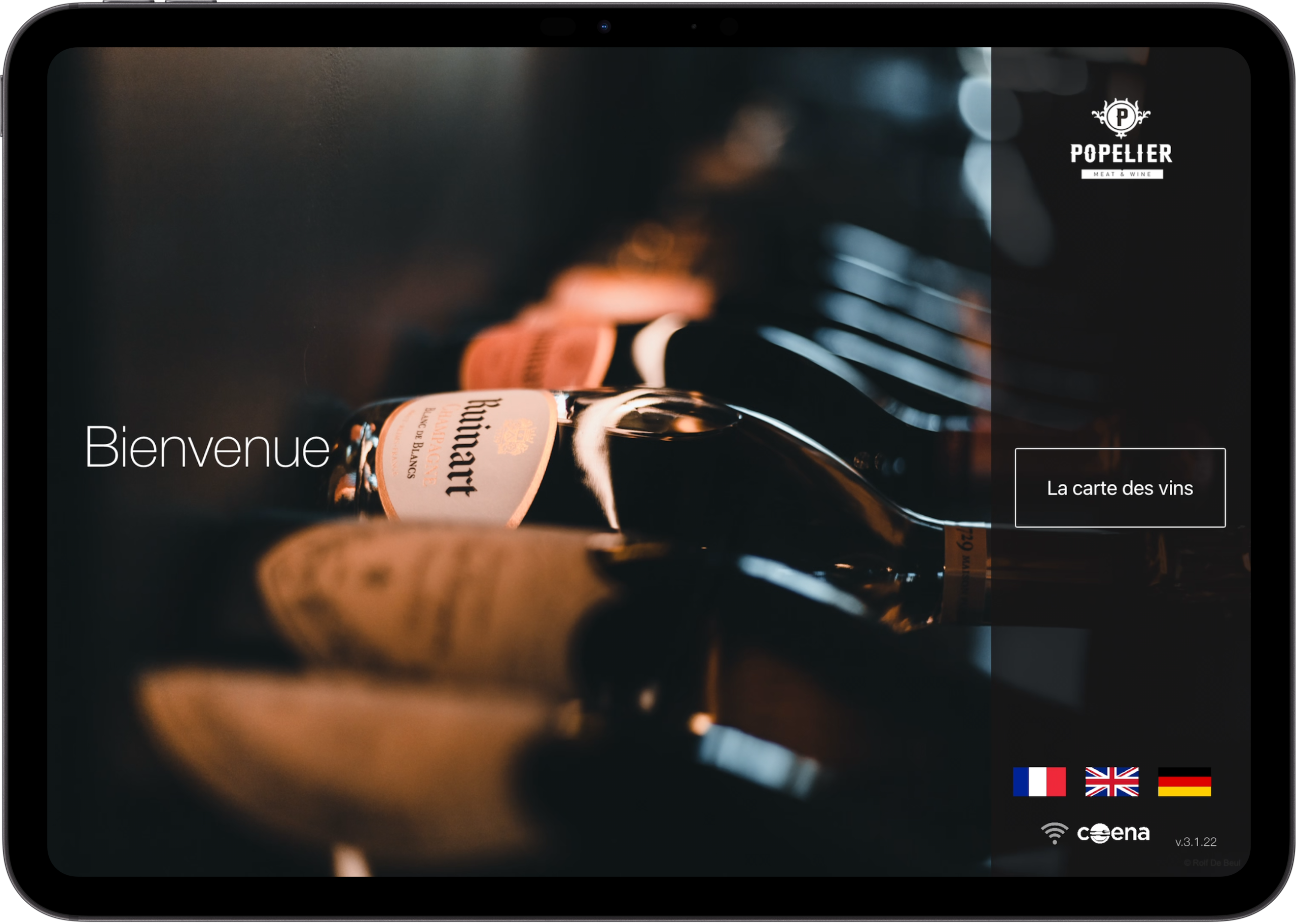
Their list also runs in three languages, which for a restaurant in Flemish Brabant drawing guests from across the border is less a nicety than a requirement.
That is the whole ambition. A list this good deserves not to be out of date by Thursday.
The company they kept
The other Silver Stars in Best Long List went to Hof van Cleve, Zilte, Restaurant Sans Cravate, Paul de Pierre, d’Oude Schuur, Marcel, Racines Bruxelles and Restaurant Gillis. The Gold Star in the category went to L’Envie in Zwevegem.
For a restaurant in a village in the Pajottenland to be listed there is not a small thing.
A second signal in the same season
Two weeks before the Belgian ceremony, Bettane+Desseauve handed out a “Carte des vins de l’année” in Paris, separately from its awards for best cellar and best sommelier. Two major juries, two countries, one month — both choosing to judge the wine list as an object in its own right.
That is a useful signal for anyone still treating the list as a printed by-product of a stock file. The guides have stopped treating it that way.
Congratulations to Joachim Pletinckx and the team at Popelier.