
Six digital wine list software platforms currently matter if you’re putting your wine list on a screen: COENA, Uncorkd, SommOne by My Wine Guide, Vinipad, Winevizer and Somm’it. They are not competing for the same job. Two are built around a tablet handed to the guest at the table, one is built around a QR code on the guest’s own phone, one is a cellar-management system that happens to output a list, and the rest sit somewhere between. Choosing well is mostly a matter of knowing which of those you’re actually buying.
COENA publishes this comparison and makes one of the products in it. We’ve kept every claim to what each vendor publishes publicly, and we’ve said plainly where COENA is the wrong choice.
At a glance
| Primary approach | Built for | At the table | Cellar & POS | Published price | |
|---|---|---|---|---|---|
| COENA | Native iPad app, admin embedded in the iPad | Fine dining, Michelin-tier houses, luxury hotels | iPad handed to the guest, offline, 6 languages | Full stock, bottle location, by-the-glass; POS via HubRise (40+ systems, one-way) | From €75/mo per venue + setup from €300 |
| Uncorkd | Web-managed iPad menus | US clubs, casinos, hotels, upscale restaurants | iPad wine, whisky, beer and cocktail lists | Menu-led; list built for you at onboarding | Reported from ~$100/mo |
| SommOne (My Wine Guide) | Digital menu across iPad, tablet, phone, eReader | US hospitality, resorts, cruise | Image-rich interactive menu, guest explores at own level | Connects to POS and inventory; by-the-glass management | On request |
| Vinipad | iPad, Android and QR menu | Restaurants, hotels, wine bars (Spain-led, international) | Tablet or QR, wine plus food and spirits | Out-of-stock hides instantly, min-stock alerts, consumption reports | App free to download; venue plan on request |
| Winevizer | QR code on the guest’s phone, tablet optional | Restaurants, wine bars, high-volume venues | Guest’s own smartphone | Manual stock from a web admin; no native POS link announced | From €25/mo, three months free |
| Somm’it | Cellar management software; the list is one output | French traditional restaurants and wine bars with real stock to run | Tablet, QR or printed from the software | The core of the product: POS-linked auto-decrement, BEV cost, margins | On request |
The six, one by one
COENA
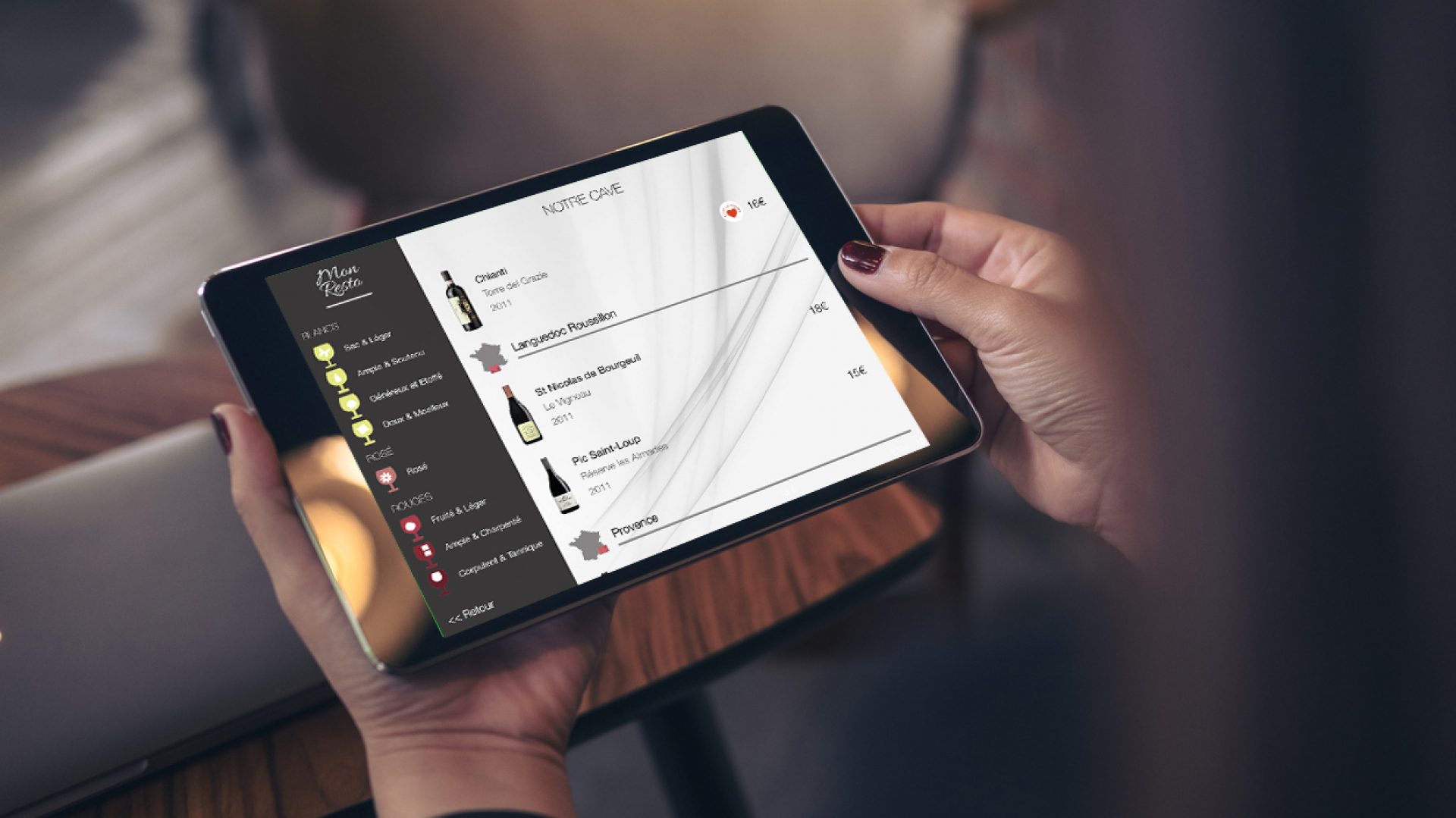
A native iPad application built for the table. The list is handed to the guest the way a printed list is, in the house’s own colours and typography, and it works with no connection at all. What’s unusual is where the admin lives: it’s embedded in the iPad itself, so a sommelier adds a vintage, changes a price or pulls a sold-out bottle mid-service, from the floor, without going to a back office. Behind the list sits real cellar depth — bottle location, by-the-glass tracking, six display languages switchable table by table — and, from the Signature tier, an AI Cellar Assistant that answers questions in plain language about the venue’s own sales and stock (“which reds were viewed most and ordered least last month”). Data is EU-hosted. Used at Michelin-starred houses and luxury hotels including the Maybourne Riviera, Le Gavroche, Le Pont de Brent and Royal Mansour.
Built for: venues where the wine list is part of the service ritual and the cellar is genuinely complex. The app is on the App Store as COENA – iPad Wine List.
Uncorkd
The longest-running iPad wine list vendor in the US, serving clubs, casinos, hotels and upscale restaurants since 2011. Covers wine, whisky, beer and cocktails on iPad, managed from a web platform, and the Uncorkd team builds your existing list out for you at onboarding rather than handing you a spreadsheet. Uncorkd reports average wine sales increases of 15–20% among its customers. Pricing isn’t published; industry reporting has put the entry point around $100 a month.
Built for: US venues, particularly clubs and casinos, wanting a full beverage programme on tablet with the setup done for them.
SommOne by My Wine Guide
Sold as a wine programme platform rather than a menu tool: SommOne Digital Cru is an image-rich interactive list that runs on iPad, tablet, phone or eReader, connects to POS and inventory, and stays current automatically. Guests can explore at their own level — tasting notes, producer stories, filtering by varietal, region, price, vintage. Strong presence in hotels, resorts and cruise.
Built for: multi-property US hospitality groups running one wine programme across many locations and device types.
Vinipad
A Spanish product, developed with sommelier input, available on iPad, Android and QR. Covers wine, food, spirits and cocktails, with searches by denomination of origin, grape, vintage, pairing and price. On the operational side, out-of-stock references disappear instantly, minimum-stock alerts arrive by email, and consumption reports track the cellar. Vinipad advertises menus ready in 48 hours and claims +15% wine sales in the first month.
Built for: venues wanting device flexibility — tablet for some tables, QR for others — without committing to one hardware ecosystem.
Winevizer
The accessible end of the market, and honest about it. The guest scans a QR code and reads the list on their own phone; a tablet is available but isn’t the main model. Entry price is €25 a month with three months free, on top of a database of more than a million references and automatic food-and-wine pairing suggestions. Stock is updated by hand from a web admin, and no native POS connection is announced.
Built for: wine bars, bistros and high-volume venues that want to be digital next week at minimal cost.
Somm’it
Not really a wine list product — a French cellar and inventory management system in which the list is one output among several. It connects to the till so stock decrements automatically on every sale, records purchase and sale prices to compute real BEV cost, and lets you reprice with margins protected. The list can be shown on a tablet, via QR, or simply printed from the software.
Built for: restaurants whose primary problem is cellar control and margin, not the object handed to the guest.
Which one fits which venue
You run a Michelin-starred restaurant or a luxury hotel and the list is part of the service. You want a native tablet handed to the guest, the house’s typography, and an admin the sommelier can drive from the floor. COENA or SommOne. If the cellar has real depth — bottle location, verticals, large formats, wines by the glass changing daily — COENA is built around exactly that.
You’re a wine bar or bistro and the priority is being digital cheaply and fast. Winevizer. €25 a month and a QR code will genuinely solve your problem. COENA’s entry tier starts at €75 a month and does a different job — if you don’t need that job doing, don’t buy it.
Your real problem is stock and margin, not presentation. Somm’it. It’s a cellar system first, and it’s very good at that job.
You’re a US club, casino or resort group. Uncorkd or SommOne — both are established in that market with the onboarding support those operations expect.
You want tablets on some tables and QR on the terrace. Vinipad, or COENA’s QR + PDF module alongside the iPads.
Where COENA is not the right choice
- If you want a QR code and nothing else. COENA includes a QR + PDF module, but you’d be paying for a cellar platform to use one feature. Winevizer or Vinipad will serve you better.
- If your list is under about 50 references and rarely changes. A well-made PDF is a legitimate answer, and we’d rather tell you that.
- If you need bottles rung directly on the POS to flow back into the list automatically. COENA syncs one way today: an order placed in COENA decrements stock; a bottle rung on the till doesn’t yet come back. Bidirectional sync is on the roadmap. If that flow is critical now, Somm’it’s till integration is deeper.
- If you’re standardising on Android tablets. COENA is iPad-native. Vinipad runs on both.
How to choose in practice
Ask three questions in this order. What is the guest holding? Their own phone, your tablet, or paper. Who edits the list, and from where? The sommelier on the floor, or someone at a computer after service. What has to stay accurate — the display or the cellar? Most venues discover their real answer is the cellar, and choose differently once they’ve said it out loud.
Then ask each vendor for a demo on your list, not a generic one. Any of the six will do it. How the list looks with your own 300 references, on the device your guest will hold, settles most of these arguments in ten minutes.
Frequently asked questions
What is the best digital wine list software for restaurants in 2026?
There’s no single best — it depends on what the guest holds and what has to stay accurate. For fine dining and luxury hotels with a deep cellar, COENA and SommOne lead. For low-cost QR-code lists, Winevizer. For cellar and margin control, Somm’it. For device flexibility, Vinipad. For US clubs and casinos, Uncorkd.
How much does digital wine list software cost?
From roughly €25 a month for a QR-code list on the guest’s own phone, to €75–225 a month per venue plus a one-off setup for a native tablet platform with cellar management behind it. COENA publishes its full pricing, tier by tier, if you want a worked example.
Is a QR code or a tablet better for a wine list?
A QR code is cheaper and faster to deploy; a tablet preserves the service ritual and doesn’t depend on the guest’s phone, battery or signal. In fine dining the tablet usually wins, because handing something to a guest is part of the job.
Do digital wine lists connect to the POS?
Some do. COENA connects through HubRise to 40+ POS systems, one way — orders placed in COENA decrement stock. Somm’it’s till integration is bidirectional and is the core of that product. Winevizer announces no native POS connection.
Do digital wine lists work without Wi-Fi?
COENA stores the list locally on each iPad and runs fully offline. QR-code solutions require the guest to have a working connection at the table.